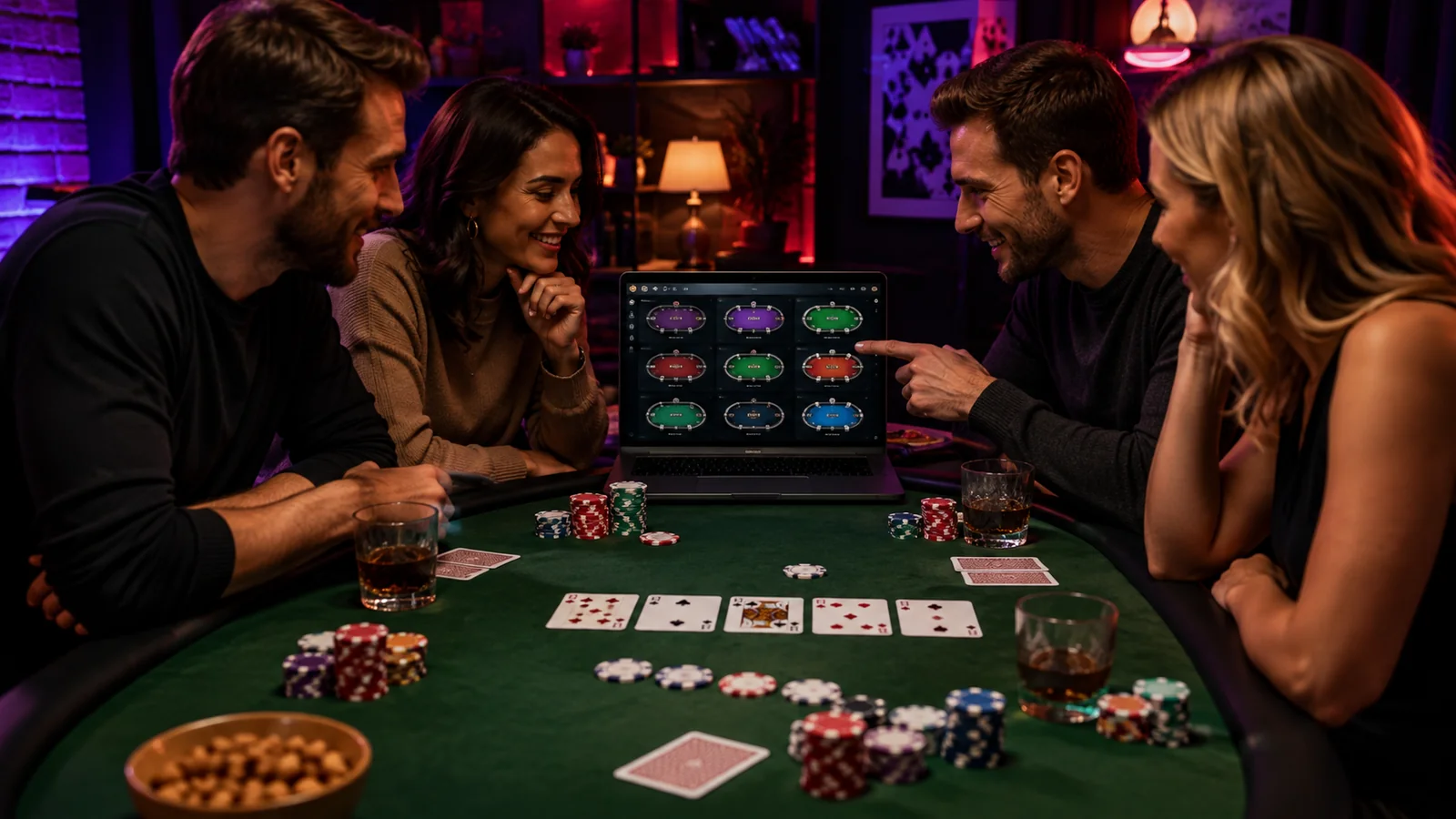
A home-game regular tries one quiet table
Imagine Priya, a hypothetical player who understands hand rankings from a monthly kitchen-table game. Online, there is no friend announcing whose turn it is, no dealer correcting an unclear chip movement, and far less conversation between hands. Priya decides the first session is for learning controls rather than proving skill.
She verifies that play is legal in her location, reads the account requirements, installs software from the official source, turns on security and limits, and explores free-play or observer features if available. Her first paid session uses one table, the lowest comfortable cost, and a short alarm. This scenario does not claim that any room was tested or that a beginner will achieve a particular result.
Translate what changes online
The rules of the poker variant may be familiar, but the operating environment is different. Betting controls, automatic blinds, time banks, chat, disconnection procedures, table waiting lists, and hand histories replace many cues from a home game. Misclicks can have financial consequences, so learn where fold, check, call, bet sizing, sit out, and leave-table controls appear before funding.
Read the room’s player guide and table rules. Confirm the variant, betting limit, table size, buy-in range, and whether any optional features change the pace. Do not assume a home rule applies online.
Complete account work away from the table
Open the account only with accurate personal information and a payment method you own. Review identity and address documents, accepted file formats, privacy information, withdrawal route, and location checks. Complete legitimate verification through the account area rather than waiting until a planned session.
Use a unique password and multifactor authentication when offered. Keep the email account attached to poker secure as well. Download desktop or mobile software from the room’s official page or the appropriate official app store, and install system updates before play.
Rehearse controls without pressure
Use free-play, tutorials, or observation where legally available to learn the interface. Adjust sound, card size, animation, contrast, and four-color deck options if offered. Find the hand-history and support paths. Locate the cashier and limit settings, then close them again. The goal is to remove interface surprises.
Practice one deliberate routine: confirm the action, read the amount, and click once. Turn off optional shortcuts until you understand them. Avoid multiple tables, rapid formats, and phone notifications during the first session. Familiarity should reduce cognitive load, not encourage faster spending.
Make the first stake intentionally small
Choose a cost that is comfortably inside a fixed entertainment budget and accept that it may be lost. A table minimum is not a recommendation, and a promotion should not determine the deposit. If the smallest available game is uncomfortable, the room is not a beginner fit.
Use one buy-in or one entry with no same-day reload. Set a deposit limit and a time reminder before the first hand. Avoid moving up because opponents appear weak or because a short result creates confidence. One session reveals only whether the routine and interface suit you.
Conduct a five-minute debrief
After the alarm, leave regardless of the balance and record practical observations: Did the controls make sense? Was the pace comfortable? Did the session end on time? Were the fee and transaction records clear? Could you find support and safer-play tools? These are more useful first-session measures than profit or loss.
If you felt rushed, hid the session, ignored the timer, or wanted to immediately recover a loss, pause before returning. Use a time-out when needed. Online access should not turn a social hobby into isolated, uncontrolled play.
Home-game habit versus online adjustment
| Home-game cue | Online replacement | First-session action |
|---|---|---|
| Dealer announces action | Visual controls and timer | Slow down and confirm each amount |
| Friends explain rules | Published player guide and support | Read before funding |
| Physical chips show spend | Digital balance and history | Set limits and record transactions |
| Natural conversation breaks | Continuous dealing | Use an external alarm |
| One shared table | Many available tables | Open only one |
Your decision checklist
- Confirm legal access and licence status for your location.
- Complete accurate account and identity steps securely.
- Install official software and enable account security.
- Find table controls, limits, support, and hand histories.
- Choose one table and one small entertainment buy-in.
- Set a short external timer with no same-day reload.
- Debrief the routine instead of judging the result.
Warning signs
- The room’s smallest game is outside your comfort budget.
- You cannot find rules, transaction history, or limit tools.
- A message asks for identity documents outside the secure account area.
- You add tables because one feels boring.
- You ignore the planned end to recover a loss.
Treat session one as orientation
Choose a licensed room whose smallest practical game, interface, security, support, and limits feel understandable before money moves. The first paid session should be short, single-table, and capped. An approved affiliate link may later make Casino How-To money, but it should never accelerate registration or replace the account checklist.
Plan the rest of your poker setup →Frequently asked questions
Should a home-game player start with multiple online tables?
No. Start with one table so there is time to learn the interface, pace, fees, and hand history without multiplying decisions.
Is free play the same as real-money poker?
No. It can help you learn controls, but it does not reproduce every financial, emotional, verification, or withdrawal decision involved in real-money play.
What should count as a successful first session?
Following the budget and end time, understanding the controls, and leaving with a clear record are useful measures. A short-term win is not proof of skill or room quality.
Sources
Sources were last checked on September 5, 2026. Rules and availability can change.
- UK Gambling Commission: What to look at before you gamble — checked 2026-09-05
- UK Gambling Commission: Opening accounts — checked 2026-09-05
- CISA: Secure Our World — checked 2026-09-05